
Vision 2030
Robotics that learns to do heavy lifting.
From a compact electric machine to a learning robotic platform for construction sites.
Discover the concept →

— 01 / The Starting Point
The construction site needs more than just a new machine.
Construction sites face growing demands and limited resources. Material transport, in particular, consumes valuable time: trucks are unloaded, materials are handled multiple times, and transported along narrow routes to their final installation location. This ties up skilled workers, machinery, and often valuable crane or hoist capacity.
The shortage of skilled labor adds to these challenges. In July 2026, 32.6% of companies in the main construction industry reported a shortage of skilled workers, according to the ifo Institute. At the same time, a study by the German Economic Institute (IW) highlights that improved processes and digitalization are key drivers of productivity in construction.
The answer, therefore, cannot simply be a bigger machine. We need machines that can perform a variety of tasks, adapt to changing environments, and leverage the knowledge and experience of skilled workers.
— 02 / Our Vision
Our Vision: Adaptive Physical AI.
By 2030, we aim to develop the QuiMo technology into a family of learning, modular robotic platforms. These platforms will be designed to autonomously pick up, transport, and precisely position loads while adapting to different tools, surfaces, and working environments.
In the long term, skilled professionals should be able to demonstrate new tasks, enabling the robots to learn them within days rather than requiring months of individual programming. This is a research and development goal, not a claim about current capabilities.
We call this approach Adaptive Physical AI. Unlike purely software-based automation, it takes the physical characteristics of the machine itself into account: How is the load distributed? How does the center of gravity shift? How much traction is available? Which movements are safe under the current conditions?
Our goal is the transition from machines operated by experts to robots that learn from experts.
— 03 / Architectural Advantage
Less Machine. More Value Per Operation.
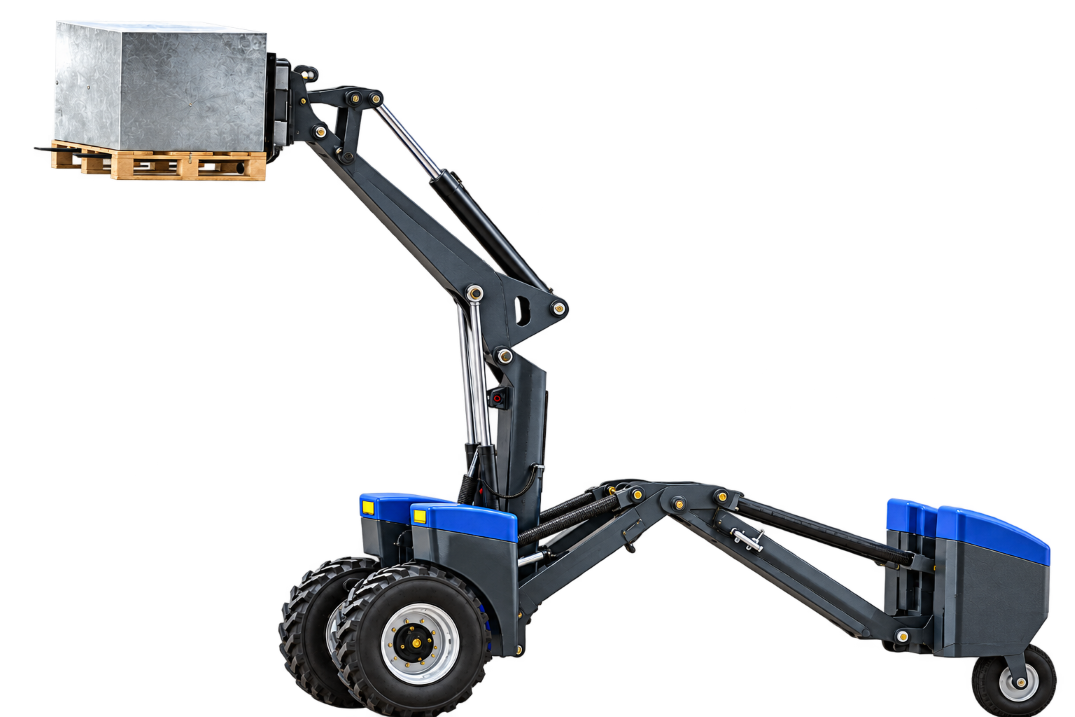
The QuiMo 1600 is currently an electrically powered, remote-controlled platform with a payload capacity of up to 1,600 kg, an operating weight of approximately 1,800 kg, and a width of just 1,200 mm. An actively adjustable counterweight helps maintain stability. Its compact design and interchangeable tools combine high physical performance with versatility.
Even before the development of autonomous capabilities, this architecture already offers significant economic opportunities:
01
Materials & Manufacturing
A lighter, simplified machine architecture can reduce steel consumption, the number of components, and manufacturing effort. The actual CO₂ and cost savings will be determined through robust comparative analyses.
02
Maintenance & Service
The electric drive system eliminates the need for a conventional hydrostatic drive. QuiMo estimates that up to seven out of ten typical maintenance tasks could be eliminated compared to diesel-powered wheel loaders.
03
Simplified Transport:
The machine’s compact weight allows it to be transported on a suitable car trailer instead of requiring complex low-loader logistics – depending on the towing vehicle, trailer, payload capacity, and applicable legal regulations.
04
More Efficient Energy Use:
Demand-driven hydraulics and an electric drive system reduce energy losses. Initial calculations indicate potential energy savings of up to 40% compared to conventional compact loaders.
— 04 / Three Technological Building Blocks
Three Building Blocks on the Path to Learning Construction Robotics
01
A Machine Body That Adapts
In the QuiMo, stability is not achieved through permanent mass alone. The movable counterweight and adjustable positioning of the attachment enable active adaptation to different load conditions.
In the future, the robotic control system is intended to anticipate narrow passages, slopes, and working movements, automatically selecting the most suitable machine configuration for each situation.

02
Real-World Experience as the Foundation for Training
We aim to equip future pilot machines with suitable sensors and capture real-world workflows together with construction professionals: movements, loads, tool positions, forces, and environmental conditions.
Human demonstrations and targeted corrections will help transform these observations into training data, supported by clear rules for data protection, consent, and safe operation.

03
Learning Grounded in Physics
A unified capability model is intended to enable tasks to be transferred across different tools and, eventually, across different QuiMo platforms.
The AI proposes movements, while a physics-based machine model and an independently designed safety layer verify and limit their execution. This separation is a development goal – not an already certified autonomous function.
— 05 / FIRST USE CASE
From the Truck to the Installation Site.
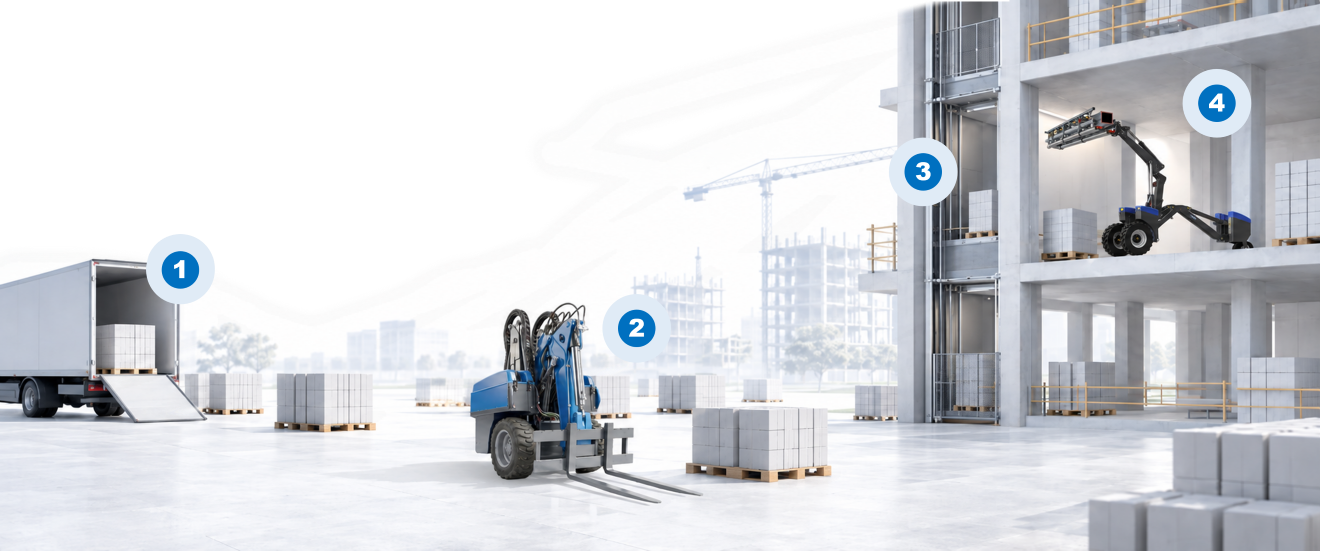
We are starting where the benefits can be measured in concrete terms: urban construction site logistics. In our vision, a QuiMo picks up materials from a truck, navigates changing routes across the construction site, and delivers them to the designated location. With different attachments, the same platform is also intended to handle bulk materials or precisely position structural components.
For renovation and construction in existing buildings, we are pursuing another size class with the QuiMo 500: planned specifications include a 500 kg payload capacity, an operating weight of approximately 600 kg, and a width of just 800 mm. In the long term, this could enable the automation of tasks beyond narrow doorways and inside existing buildings.
1
Autonomous Unloading
Handling a wide variety of loads using different attachments.
2
Adaptive Transport & Positioning
Navigation across changing construction sites while accounting for spatial constraints.
3
Cross-Robot Handover
Shared capabilities and handover processes between the QuiMo 1600 and QuiMo 500.
4
Indoor Material Positioning & Installation
Precise positioning of materials and installation of modules and technical equipment while complying with permissible floor and structural load limits.
The Gap
Robots That Learn Can't Lift.
Machines That Lift Cannot Learn.
Today, learning robots primarily handle lightweight loads. Heavy machinery moves tons of material, but automation often requires extensive development for individual tasks. QuiMo aims to bring both capabilities together.